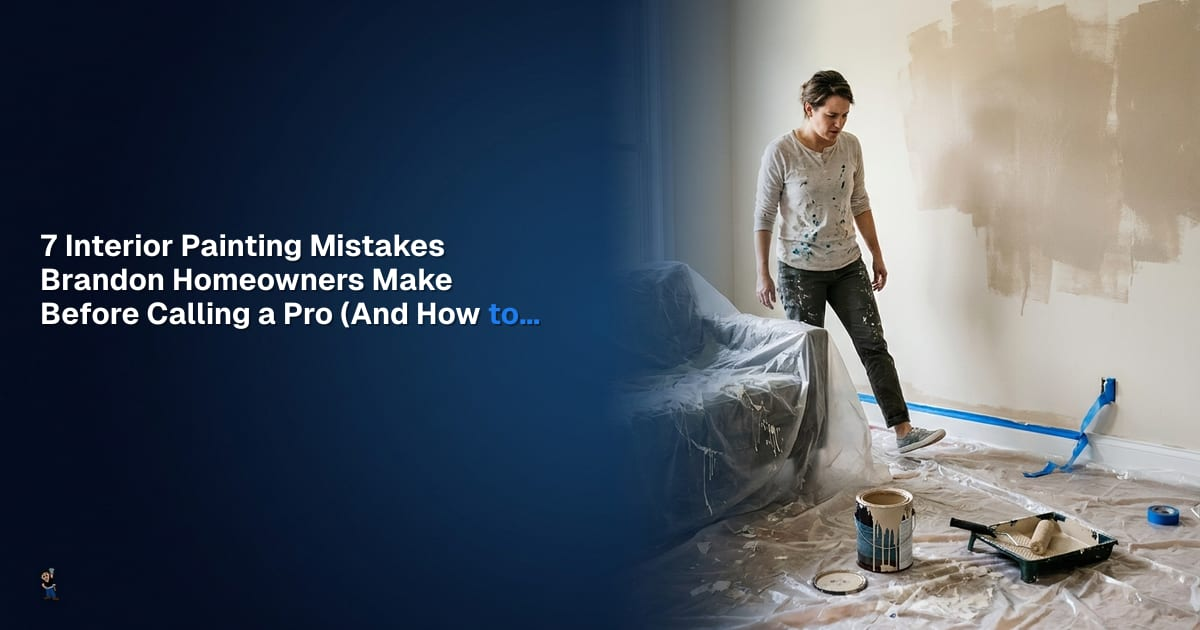
It’s a familiar feeling. You spent the entire weekend taping, rolling, and cutting in. You step back, exhausted but proud. But when you see the room in the clear light of Monday morning, your heart sinks. You spot the faint streaks, the fuzzy texture from the roller, and that one spot near the ceiling that isn’t quite straight. A great paint job feels like it should be simple, but the truth is, a truly professional finish is a different beast entirely.
Here in Brandon, we’ve seen it all. Homeowners are often surprised that a flawless interior painting result is less about the act of painting and more about getting every single step leading up to it right. Before you pick up another roller, let’s walk through the seven most common mistakes we see people make, and more importantly, how you can avoid them for good.
1. Believing ‘Prep’ Just Means Laying Down a Tarp
This is, without a doubt, the biggest one. Tossing a drop cloth on the floor is the bare minimum. Real preparation is where the magic happens, and it’s honestly 80% of the job. It means meticulously cleaning the walls to remove dust, grease, and grime that prevent paint from sticking. It means finding and filling every single nail hole, crack, and dent, then sanding those patches perfectly smooth so they disappear.

In Florida, this is even more critical. Our humidity can trap microscopic layers of moisture and contaminants on the wall surface. Painting over that is a recipe for peeling and bubbling down the road. If you’ve ever had issues with your drywall, like stress cracks or old repairs, getting that surface perfect is a non-negotiable first step. We see many jobs fail because of improperly handled common drywall problems before a single can of paint is even opened.
2. Thinking All Gallons of Paint Are Created Equal
Walking into a big-box store and grabbing the cheapest gallon of paint is one of the most expensive mistakes you can make. It sounds contradictory, but it’s true. Cheaper paints have fewer solids (the pigments and binders that create the color and finish) and more water. This means you’ll be applying three, maybe even four, coats to get the same coverage that a premium paint provides in two.
Honestly, the move here is to buy the best paint you can afford. A $70 gallon that covers beautifully in two coats is far cheaper than two $40 gallons that require three coats plus the extra hours of your life you’ll never get back. For homes in the Tampa Bay area, we also recommend looking for paints with mildewcide additives, especially for bathrooms and kitchens, to combat our year-round humidity.
3. Grabbing the Cheapest Rollers and Brushes
You’ve invested in good paint, so don’t sabotage it with bad tools. Those bargain-bin roller covers are notorious for shedding lint directly onto your wall, leaving you with a fuzzy, uneven texture. Cheap brushes don’t hold enough paint and leave visible brush strokes, especially when you’re trying to get a clean line, or ‘cut in’, along trim and ceilings.
Rollers: Match the ‘nap’ (the thickness of the roller material) to your wall texture. A 3/8-inch nap is great for smooth walls, while a 1/2-inch nap is better for light texture.
Brushes: A high-quality 2.5-inch angled sash brush is the workhorse of professional painting. It holds more paint, releases it evenly, and gives you the control needed for sharp lines.
We’ve been called to fix jobs where the only solution was to let the fuzzy paint dry, sand the entire wall down, and start from scratch. It’s a painful lesson to learn.
4. Treating Primer as an ‘Optional’ Step
Primer isn’t just ‘pre-paint’. It’s a specialized foundation designed to solve problems. Are you painting a light color over a dark one? Primer will stop the old color from ghosting through. Do you have patched spots on the wall? Primer seals the patch so it doesn’t ‘flash’ or show through the topcoat with a different sheen. Did the previous owners smoke? A good stain-blocking primer is the only way to permanently seal in those odors and stains.
For us, primer is rarely optional. It ensures the final color is true, the finish is uniform, and the bond to the wall is as strong as possible. It’s the difference between a paint job that looks good for a year and one that looks great for a decade.
5. Trying to Finish a Two-Day Job in One Afternoon
Patience is a painter’s most underrated tool. When you patch a wall, the compound needs to dry completely before you sand it. When you prime, it needs to dry completely before you paint. And most importantly, your first coat of paint must be fully cured before you apply the second. The instructions on the can are there for a reason.
Here in Brandon, our humidity can easily double the recommended dry times. Rushing a second coat onto tacky paint will pull the first coat right off the wall, creating a gummy mess. And if you’re working on a home built before 1978, you have to consider the potential for lead paint, which has its own set of rules for safe handling. The EPA has strict guidelines for this, as outlined in its Renovation, Repair and Painting Program, which a professional will always follow.

6. Wobbly Lines and ‘Bleeding’ Edges
Nothing screams ‘DIY’ like a wavy line where the wall meets the ceiling or paint bleeding under your painter’s tape. Getting crisp, straight lines is a skill that looks deceptively easy on TV but takes hundreds of hours to master. While painter’s tape can help, it’s not foolproof.
A pro tip: after applying the tape, run a putty knife or a credit card along the edge to seal it firmly. This prevents the paint from wicking underneath. But ultimately, a steady hand and a high-quality angled brush are what create those laser-sharp lines. It’s one of the clearest distinctions between a good-enough job and a professional one.
7. Forgetting a Paint Job Takes Over Your Home
The final mistake is underestimating the sheer disruption. It’s not just a few hours of rolling. It’s moving all the furniture into the center of the room, covering everything in plastic, the fine dust from sanding that gets everywhere, the paint fumes, and having a room be unusable for days. A weekend project can easily stretch into a week-long ordeal that takes over your living space.

This is often the point where homeowners decide to call for help. A professional team is built for efficiency. We can often complete a project in a fraction of the time, and we manage the entire process, from prep to a thorough cleanup. It’s especially important to have a clear plan if your project involves more than just paint, like coordinating with a flooring installation, to minimize downtime.
The Real Cost of a ‘Cheap’ Paint Job
As you can see, a ‘simple’ painting project has a lot of moving parts. When you factor in the cost of quality materials, the right tools, and the value of your own time (and sanity), the ‘cheap’ DIY route can quickly become more expensive than you ever imagined. A professional job isn’t just about applying paint; it’s about delivering a durable, beautiful result that enhances your home’s value without the headache.
Your biggest investment is time: Proper preparation is slow and meticulous, but it’s the only path to a lasting finish.
Quality pays for itself: Better paint and tools save you from having to do the work twice.
Respect the humidity: Florida’s climate changes the rules. You have to allow for longer drying times.
A pro manages the whole process: The real value is getting an expert result without the mess, stress, and disruption to your life.
If you’ve run into these issues and are tired of the DIY struggle, it might be time to consider a different approach. When you want to see how Handyman Walter ensures a perfect finish by getting these details right from the start, let’s talk about your project.